
Bands
Bands 0-9 / A
Bands Ba-Bk
Bands Bl-Bz
Bands C
Bands D-E
Bands F-H
Bands I-L
Bands M-O
Bands P-Si
Bands Sm-Sz
Bands T-W
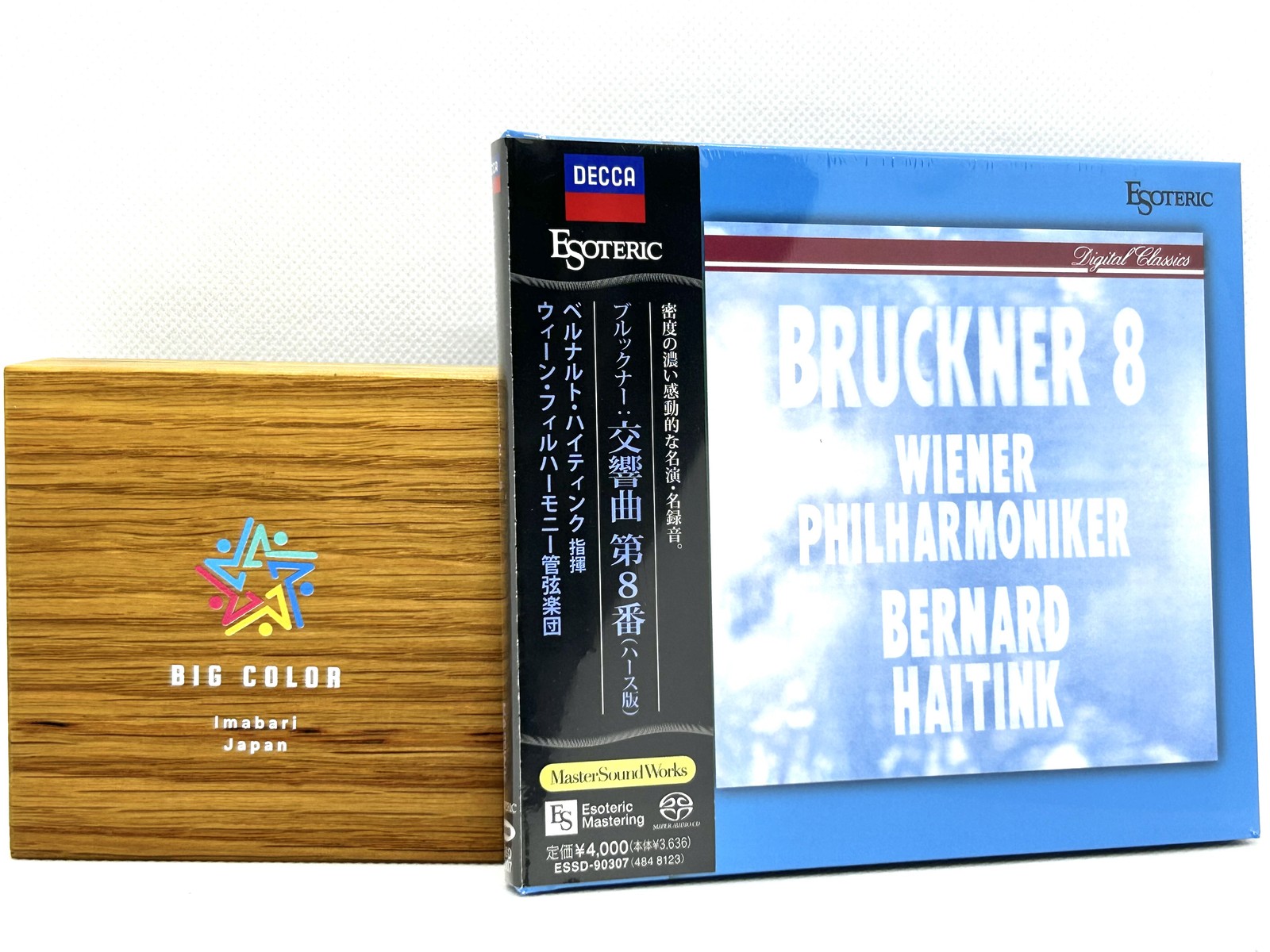
ESOTERIC ESSD-90307 Bruckner Symphony No. 8 Haitink VPO SACD Hybrid Remaster For Sale
 When you click on links to various merchants on this site and make a purchase, this can result in this site earning a commission. Affiliate programs and affiliations include, but are not limited to, the eBay Partner Network.

ESOTERIC ESSD-90307 Bruckner Symphony No. 8 Haitink VPO SACD Hybrid Remaster:
$55.99
Click here to see all products in our store!* International Buyers - Please Note:
Import Duties & Taxes PolicyUnited States
All shipments to the U.S. are sent DDP (Delivered Duty Paid). Import duty, taxes and brokerage are prepaid — no extra payment at delivery.
Other Countries
Unless duties/taxes are already collected by at checkout, shipments are sent DDU (Delivered Duty Unpaid) and the buyer is responsible for import VAT/GST, duty, and carrier fees on delivery.
*Description
The culmination of the Bruckner recordings with the Vienna Philharmonic, which began in the CD era.
The mature Bruckner sound created by Haitink in his later years with the Vienna Philharmonic.
World's first remastering and Super Audio CD hybridization realized.
[Track List]
Anton Bruckner: Symphony No. 8 in C minor, Haas Edition
1. First Movement: Allegro moderato
2. Second Movement: Scherzo (Allegro moderato)
3. Third Movement: Adagio (Feierlich langsam, doch nicht schleppend)
4. Fourth Movement: Finale (Feierlich, nicht schnell)
Conductor: Bernard Haitink
Performers: Vienna Philharmonic Orchestra
Recording: January 10-13, 1995, Vienna, Musikverein, Grosser Saal
Bernhard Haitink (1929–2021) retired from conducting at the age of 90 after his final performance of Bruckner's Symphony No. 7 with the Vienna Philharmonic at the Lucerne Festival in September 2019, and passed away two years later.
Starting his career as a violinist, Haitink studied conducting under Ferdinand Leitner before becoming assistant conductor of the Netherlands Radio Philharmonic Orchestra in 1955 and its chief conductor in 1957. He gained international attention in 1961,when he was appointed chief conductor of the prestigious Amsterdam Concertgebouw Orchestra at the age of just 32.
Although he was initially supported by Jochum as his assistant, Haitink remained with the orchestra for 28 years until 1988, nurturing it from a leading Dutch ensemble into one of the world's finest.
He held prominent positions with world-class orchestras and opera companies, including the London Philharmonic (1967–79), the Royal Opera in London (1987–2002), the Boston Symphony Orchestra, the Staatskapelle Dresden, and the Chicago Symphony Orchestra, and for over 60 years, he was a leading figure in the conducting world from the latter half of the 20th century.
What sets Haitink apart is the extensive recording activity he pursued alongside his conducting career.
Following his recording of Beethoven's Symphony No. 8 and Mendelssohn's Symphony No. 4 with the Concertgebouw Orchestra before his appointment as its music director in 1959, he built an extensive discography spanning from Haydn to Toru Takemitsu for the Dutch label Philips, which emerged after World War II.
It was only natural that the Netherlands' leading orchestra would be supported by the country's leading label, and at a time when there was a growing demand for new catalogs utilizing the new stereo technology, the young Haitink released a series of recordings of standard repertoire with the renowned orchestra, establishing his name on the world stage.
Among these, the complete symphonies of the two great late Romantic composers, Bruckner (1963-72) and Mahler (1962-71), which he began recording in the 1960s and completed in the early 1970s, were particularly highly acclaimed.
The former was the second stereo recording of Bruckner's symphonies, following Jochum's DG recording, and the first complete set recorded with a single orchestra, including the Unfinished Symphony. The latter was the third complete set of Mahler's symphonies, following Bernstein's CBS recording and Kubelik's DG recording,Kubelik's DG recordings, making it the third complete set in history. This coincided with the widespread adoption of stereo playback systems in homes, greatly enhancing Haitink's artistic image as a master of Bruckner and Mahler on disc.
The fact that he recorded Bruckner and Mahler before Beethoven and Brahms' symphony cycles was also a departure from the conductors of the past, and served to publicize the innovative repertoire policy of the then-young Philips label.
Haitink's meticulous and sincere musicality, which did not compromise on detail, demonstrated a strong affinity with Bruckner's works even more than with Mahler's, and perhaps because of this, Haitink continued to re-record them over the years.
In the late analog to early digital era, he re-recorded the last three symphonies (Nos. 7–9) with the Concertgebouw Orchestra, demonstrating his mature and expansive style.
Furthermore, starting in 1985, he began re-recording with the Vienna Philharmonic Orchestra, releasing the fourth symphony in 1988, followed by the third and fifth symphonies in 1988, all part of a “complete recording” project. These recordings delved even deeper into the essence of Bruckner's works than his earlier recordings.
After a seven-year hiatus, the Symphony No. 8, recorded in 1995, is now being released for the first time in this series as a hybrid recording.
Recorded over four days from January 10 to 13 (presumably including rehearsals), the performance was followed by two regular concerts and tours to Linz, Paris, London, and Toulouse.
The process of recording the performance after a thorough rehearsal session, rather than a live recording, is a luxurious recording format that is rarely realized today, reflecting the commitment of Philips.
Although this recording was the last in the Bruckner symphony cycle with the Vienna Philharmonic for Philips, Haitink continued to perform Bruckner's symphonies with the orchestra, including the Eighth Symphony in 1998, 2002, and 2015.
Since the 1980s, the Vienna Philharmonic has recorded Bruckner's Symphony No. 8 with five conductors: Giulini, Karajan (released in this series), Haitink, Boulez, and Thielemann.
Among these, Haitink's recording is remarkably natural, allowing listeners to fully immerse themselves in the beauty of Bruckner's music without the conductor's subjective interpretation.
The Vienna Philharmonic responds to Haitink's conducting with its warm sound, showcasing the distinctive timbres of the woodwind instruments, particularly the oboes and clarinets, the rich Vienna horns, and the string section, which is thick yet not overly ornate, allowing you to fully appreciate the unique qualities of the Vienna Philharmonic.
The tempo is neither too slow nor too fast, but just right, carefully opening the door to the charm of Bruckner's orchestration.
The edition and draft used in Bruckner's symphonies are often a topic of discussion, but Haitink, who was basically a supporter of the old complete edition, used the second draft edited by Robert Haas, published in 1939, for this Symphony No. 8 as well.
Although this edition, which was revised by Haas without consulting the composer, has fallen out of favor in the 21st century, the transitional passages (created by Haas) that embody the image of Bruckner in the mid-20th century are unique to this edition and give it historical value.
The recording was made in a pure session without an audience at the Musikverein.
The producer was Volker Straus (1936-2002), a veteran of Philips.
He was a renowned producer who was responsible for many of Philips' major classical recordings from the late analog era to the digital era, and was one of the key figures in establishing the image of “warm and European Philips sound” in Japan.
The Vienna Philharmonic's first Philips recording was the Brahms “German Requiem” conducted by Haitink in 1980. While the number of recordings is not as extensive as those under the same Universal umbrella label, Deutsche Grammophon and Decca, this series features notable recordings such as Haitink's Bruckner and Previn's ‘Scheherazade’ and “Exhibition.”
Despite being recorded without an audience, the sound is not overly resonant, allowing each section of the orchestra to be clearly heard, while also showcasing the massive, organ-like sound characteristic of Bruckner's music.
*Shipping
We ship using FedEx, DHL and UPS or Japan Post.
*Payment
We usually ship within 3〜7 business days of receiving cleared payment.
Related Items:
ESOTERIC ESSD-90307 Bruckner Symphony No. 8 Haitink VPO SACD Hybrid Remaster
$55.99
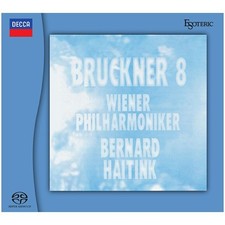
ESOTERIC SACD ESSD-90307 BRUCKNER Symphony No. 8 HAITINK
$54.68
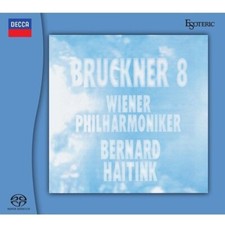
ESOTERIC SACD ESSD-90307 BRUCKNER Symphony No. 8 HAITINK
$109.99

Coming Soon
- a teens
- AC/DC
- AKA
- al green
- alan jackson
- Alice Cooper
- Alien Ant Farm
- Allman Brothers, the
- Alton Ellis